- Рейтинг Литрес:5
Полная версия:
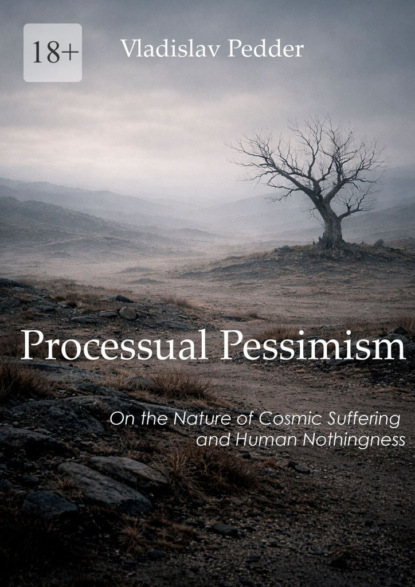
Vladislav Pedder Processual Pessimism. On the Nature of Cosmic Suffering and Human Nothingness
- + Увеличить шрифт
- - Уменьшить шрифт
On the basis of this model and the collected examples the authors extrapolate the obtained specific results to a more general tendency: informational subsystems that possess mechanisms of copying, correction, and selection tend to maintain or locally reduce Shannon entropy at the cost of external energy supply and heat dissipation. I will return later to the role of entropy reduction by living systems; for now it is sufficient to say briefly that all such activity serves to increase and accelerate overall entropy. The authors formulate this as a practical-directionality principle of infodynamics. In their conclusion they write:
“The second law of infodynamics states that the information entropy of systems containing information states must remain constant or decrease over time, reaching a certain minimum value at equilibrium. This is very interesting because it is in total opposition to the second law of thermodynamics, which describes the time evolution of the physical entropy that must increase up to a maximum value at equilibrium. […] second law of infodynamics is universally applicable to any system containing information states, including biological systems and digital data. Remarkably, this indicates that the evolution of biological life tends in such a way that genetic mutations are not just random events as per the current Darwinian consensus, but instead undergo genetic mutations according to the second law of infodynamics, minimizing their information entropy. […] Therefore, the second law of infodynamics is not just a cosmological necessity, but since it is required to fulfill the second law of thermodynamics, we can conclude that this new physics law proves that information is indeed physical.”.23
However, once again, their conclusion does not contradict the second law of thermodynamics, since any local decrease in Shannon entropy requires external energy costs and is accompanied by heat dissipation, as a result of which the total entropy of the “system plus environment” does not decrease.
The conclusion they carefully note is that systematic signs of “optimization” and compression of information representations can enhance the attractiveness of hypotheses that talk about the computational or algorithmic nature of the environment, i.e. hypotheses of simulation and virtual worlds (their article is called that: The Second Law of infodynamics and its implications for the simulated universe hypothesis), however, these observations alone do not prove such a hypothesis. – they only create an additional empirical context in which such interpretations become the subject of a correct scientific and philosophical discussion.
Death of the Universe
Continuing the discussion of cosmic pessimism, one cannot avoid the final outcome – the death of the Universe. The death of the Universe, like its birth, is a question under constant scientific revision, and we have various scenarios for the cessation of all processes in the Universe.
Within contemporary cosmological models the most likely scenario is considered to be heat death of the universe, or the “Big Freeze.” According to this hypothesis, which follows from extrapolating the second law of thermodynamics to the whole Universe, a closed system must, over time, approach a state of maximal entropy – complete thermodynamic equilibrium. If the Universe is flat or open and expands forever, and recent observations indicate a positive cosmological constant (dark energy), then its evolution will tend toward exactly such a state.
Against the backdrop of this most probable and terminal end, the popular philosophical conception of the eternal return stands out as a particularly vivid and cruel contrast; it is one of the central ideas of Friedrich Nietzsche’s philosophy. It should be said at once that because the state of heat death is not the same phase as an inflationary or false vacuum, a repeat fluctuation of comparable scale is practically impossible; the Universe does not return to the beginning, to before the Big Bang. It is only approaching the most probable macroscopic state, a state of high entropy equilibrium, in which any potential return to the beginning has already been completely erased and cannot be repeated. In the model of eternal return the Universe does not reach a finale such as heat death or a Big Crunch, but cyclically undergoes innumerable phases of birth and decay. After each “end” a new “birth” inevitably follows, along with the revival of macrostructures capable of supporting life and consciousness. Every configuration of matter, every fleeting moment of being, will be reproduced again and again, to infinity.
The idea of the “eternal” produces a harsher prospect than final “nonexistence”: if heat death allows one to imagine – however abstractly – a point at which suffering finally ceases, eternal return deprives us even of that delay. All moments of joy and terror, every pain and every pleasure, will be replayed indefinitely, without euphemistic “last breaths” and without release from the dissipative cycle. Eternal return implies an unending history already determined by deterministic mechanics.
Another possibility, the Big Crunch scenario, although unlikely in light of current data, represents a collective return to a singularity in which all complexity and diversity accumulated during the Universe’s evolution collapse into an unstructured state. Here even the possibility of fluctuations disappears; everything is reduced to zero – not as the attainment of some good or rest, but as the result of catastrophic collapse in which all traces of existence and suffering vanish. If the driving force were the dynamics of dark energy with parameters leading to a Big Crunch, suffering would take the form of rapid yet merciless destruction of the very fabric of space. All order – from galaxies to elementary particles – would be torn apart, without remainder, without mitigation, without meaning. This scenario is no less tragic, but the tragedy is expressed not in slow extinction but in a swift rupture when the very nature of interactions ceases to exist.
But there is also a seemingly paradoxical idea of the continuation of heat death, arising at the junction of thermodynamics, cosmology and philosophy of the observer, the hypothesis of the “Boltzmann brain”. This hypothesis is related to ideas such as simulation or virtuality, and is no less intriguing. It is named for Ludwig Boltzmann, one of the founders of statistical physics, who suggested that our ordered Universe might be a gigantic random fluctuation in an originally chaotic, thermally equilibrated matter. A “Boltzmann brain” is a thought experiment representing the extreme development of that logic. If in an eternal and essentially equilibrium Universe (for example, after heat death) arbitrarily unlikely fluctuations are possible, then it is statistically far more probable that a single, fully formed self-aware brain with the illusion of memory and an external world would spontaneously arise than that a whole ordered Universe like ours would fluctuate into existence. Such a brain would appear for an instant, experience a subjective episode (including perhaps reading these lines), and immediately dissolve back into chaos. From this point of view, with vastly greater probability we should be such ephemeral “Boltzmann brains” rather than products of 13.8 billion years of cosmic evolution in a sustained low-entropy environment. The fact that we observe a large, complex, and self-consistent Universe serves as a strong argument against the classical Boltzmann scenario. Yet in the modern context of an eternally exponentially expanding Universe immersed in a de Sitter vacuum, this paradox acquires a new resonance. Although in such a vacuum large fluctuations are vanishingly rare, its duration is infinite. Over infinite time even the most improbable event can (and will) occur an infinite number of times. Over the infinite horizon of such an “eternal dusk,” the total number of randomly arising “Boltzmann brains” may exceed by many orders of magnitude the number of “ordinary” observers born in the stellar epoch. This creates a serious problem for the predictive power of cosmology: if most rational perspectives in the Universe are fleeting groundless illusions, how justified is our trust in any, even the most reliable, scientific data obtained by observation?
Some interpretations of quantum mechanics (for example, the many-worlds interpretation) offer potential ways to resolve this paradox, since branching of reality alters probability accounting. Others regard it as an indication that our current cosmological model is incomplete and that the de Sitter phase is not absolutely stable or eternal. In any case, the Boltzmann brain serves as a stringent test of the internal consistency of our theories about the final fate and the very nature of reality. It exposes the tension between impersonal statistical physics and the fact of a structured observer’s existence.
This is, in its way, an attractive hypothesis among several hypotheses about the end of the Universe; however, in all these cases the ultimate fate of the Universe does not imply deliverance from suffering through attainment of some meaning or transcendent order. Suffering is the inevitable byproduct of processes that drive toward maximization of entropy. The final state is not triumph or liberation but the complete degeneration of the potential for experience. But we will not be there then (although the question of where we are still remains unresolved); our lives will end earlier, and this text will not reach the last people. Life will probably end long before the Universe completes its history, and all that remains is to remember that, in this light, nothing is important for human beings – and to remember not for survival, not for descendants, but out of an inner honesty in the face of one’s own position within the structure of reality.
The sensation of illusory consciousness, arising as a by-product of processes of ordering and replication, is doomed to disappear long before the final stages of cosmological degradation arrive. Humanity, biological life, even artificial forms of organized complexity – all are local and temporary phenomena. It is most likely that all life will terminate within the next billions of years – through the fading of stars, the collapse of biospheres, catastrophic fluctuations, or simply the statistical exhaustion of the conditions necessary to sustain Differentiating experience. The final stages of the Universe’s history will play out without a witness, in absolute emptiness or in a rapid disintegration. No “we” will remain there, no observer.
And yet – it is important to remember one’s own disappearance within the context of the thermodynamic fate of all being: memento mori. Cultural memes are high-level informational structures subject to the same physical constraints as any other organized system. Thus the very existence of cultural structures, the memory of suffering, the symbolic fixation of experience – all are mere temporary islands of order, whose price is paid in heat release and entropic damage to the surroundings. Even if suffering vanishes as a phenomenon of subjective experience, its trace remains as an informational imprint included in the overall thermodynamic accounting; every pain, every act of memory, every signal transmitted between structures leaves an irreversible mark on the state of the system. Thus the tragic ceases to be a characteristic unique to the human or the living: it is simply a localized loss of differences, an entropic decay of configuration, whether that configuration is a star, a cell, a neural network, or a text. A structure capable of distinguishing is destroyed, and in that destruction an irrevocable loss of information occurs – information that cannot be reproduced, restored, or separated from the general stream of irreversible states. That alone suffices to regard the Universe not as neutral but as tragically consummated.
Many find it difficult to imagine that Nothing – the very reverse of our world – could have given rise to all that exists. We react to “Nothing” according to temperament. Before reconciliation with thoughts of our future demise it frightens people, but then comes the understanding that, like death itself, it is no more than an idea that a person can never feel or fully comprehend. Fear of “Nothing” drove Heidegger to existential dread: he transformed “Nothing” into an almost sacred image, into the ultimate cause of philosophical constructions. Heidegger surrounded “Nothing” with an aura of mystical depth, as if attempting to elevate his concept above science itself. Such an approach is readily reproduced in pseudoscientific concepts: insert a couple of his “existential” terms into a text and the hypothesis automatically acquires an appearance of grandeur. But this is not Heidegger’s fault; he explored the topic of “Nothing” well, in his characteristic manner and within the framework of existentialism. We must, however, abandon biocentrism. Nothing is not material and cannot be a “thing” or a “substance” – it is our anthropic interpretation of the absence of presence within certain bounds of perception, if one uses it to describe a phenomenon analogously to zero in arithmetic. When we pronounce the word “nothing,” we do not summon some secret entity; we merely indicate the absence of something. The meaning of the word is determined by its use in language, and “nothing” is used to show that there is no object, no quality, no process. Objections may arise that because we use the word, it is in some way contained within our world. When we speak of some creature – say, a “dragon” – we in fact assemble familiar elements: wings (bat), scales (reptile), fiery breath (fire), and so on. All those components already exist in our language and experience, so although the “dragon” is mythological, it rests upon them: we can describe each attribute by means of actually existing concepts. “Nothing” does not operate in this way. It is not a combination of known images and not the negation of one or two properties (as in “airless,” “lifeless”). It is the sign of absolute absence – the point at which all categories end. When we say “nothing,” we are not constructing a new object from already known elements; we are placing a minus sign before all names: not substance, not space, not time, not quality, and not quantity. For that reason “nothing” cannot be “filled” or “decomposed” – it itself is the zero in the ontological account. Moreover, when we refrain from attributing any secret powers or substances to “nothing,” the fear of it immediately dissipates: it is simply an indication of absence, not some hidden entity that could harm or enslave us.
We must come to terms with the fact that actual cosmic “nothing” is governed by strict laws and mathematical equations, not by a philosopher’s existential anguish. Once the fear of “Nothing” recedes, it will be striking to observe how defenders of personhood and metaphysics continue to construct ever more elaborate edifices – multiverses or many-worlds interpretations – merely to preserve a sense of control. Perhaps this methodological compromise is inevitable while our conceptual instruments remain imperfect.
Critique of the Teleology of Nonbeing
Thus we have concluded that the Universe is moving toward a state of maximal entropy – toward heat death, toward complete thermodynamic equilibrium. Entropy steadily increases, order disintegrates, information disperses. One might conclude, simply and grimly, that all being tends toward nonbeing, that all existence is drawn to its own annihilation. Is not heat death a return to Nothing? Is not maximal entropy the disappearance of any determinacy, any difference, any existence as such?
If one accepts this logic, a whole spectrum of teleological speculations opens before us. The origins of this dark tradition can be discerned in ancient pessimism – in the teaching of Hegesias of Cyrene, nicknamed “the Teacher of Death,” or in the ascetic movements of ancient India such as the Ajivika. Yet it reaches systematic form only in the nineteenth century – from this premise the philosophy of Philipp Mainländer was born, and it continues to attract some contemporaries. Frankly, for any pessimist the idea seems tempting. I myself would be glad to draw such a conclusion. It offers an ontological simplicity: a world that arose from nothing and strives to return there sounds aesthetically pleasing and, in a sense, consoling. But is that really so? Before turning to the arguments, I will briefly define what I mean by the different senses of the word “nonbeing” – this will remove confusion and set clear bearings for the subsequent discussion.
Metaphysical (ontological) “nothing.” The absolute absence of being in the most radical sense: the lack of any entity, field, energy, or structure. In our physical world this concept belongs to metaphysical speculation, since we cannot verify it empirically, but we can speak of “nothing” as the origin of the Universe, not as its terminus. The teleology of nonbeing in the title of this section is, in this case, an ontological explanation of the world’s development by final, purposive causes – namely: attainment of nonbeing, total annihilation, absolute “nothing.” Contemporary science, when considering hypothetical scenarios for the end of the Universe, concludes that the world may sink into darkness as an extreme equilibrium, but it does not assert the arrival of absolute “nothing.” The Universe may indeed have arisen from nonbeing, as I argued earlier, and the tendency to move toward a stable state via entropy is observable; yet the likely outcome of entropy – heat death – will not lead to absolute nonbeing but to a state of thermodynamic equilibrium that can be called “equilibrium being.” This is a world deprived of directed processes, but still existent in the sense of distributed energies, where no interaction is possible and no experience exists.
Physical (thermodynamic) “nonbeing” – “equilibrium being.” This is the outcome of thermodynamic and cosmological scenarios (for example, heat death): a state in which directed processes disappear, the flow of available energy is leveled, and conditions for interactions and experience are effectively absent. It is still “something” – distributed energy and particles – but not suitable for life or meaning. In the text this designation will serve to denote the scientifically intelligible, empirical result of entropic processes.
Phenomenological (subjective) “nonbeing.” Nonbeing as the loss of subjective experience: the disintegration of personality, “death in life,” the state of sleep in which the coherent stream of the “I” vanishes. This is a local, relative “nonbeing” for one who previously possessed inner integrity and interests; it is neither identical to metaphysical “nothing” nor to the thermodynamic state.
If one speaks of nonbeing purely philosophically rather than scientifically, of course one may imagine it in various forms. For example, a system that called itself “I” can be destroyed to such an extent that what follows for it can be called the nonbeing of consciousness – “death in life” – certainly not absolute void, but metaphysically the end of a structure whose internal self-experience provided a sense of unity. The same can be said of sleep or death. Death as the disintegration of personality (including physically) may be called nonbeing. But not death per se, since that is no more than the redistribution of matter into a new state. At the same time the structure that was a Bearer of interest disintegrates, and for it this is “nonbeing.” Sleep may be called “nonbeing” for the mind: an experience of temporary loss of self-connected narratives when the stream of conscious representations is interrupted while the body continues to function; yet sleep is not absolute nonbeing – it merely demonstrates that the state of “I” can temporarily vanish and reemerge without destruction of the bearer. This distinction between metaphysical “nothing” and the physical is critical for an honest pessimism. It would be an oversimplification to speak of nothing within existing being; therefore, when philosophy speaks of nonbeing, it is pure speculation or deliberate simplification.
The Universe will not “become nothing” in the absolute sense – roughly speaking, matter and fields will not vanish entirely. The only scientific place in contemporary hypotheses and theories that touches on “nothing” within already existing being (distinct from nothing before being) is the false-vacuum scenario and its decay; but this is a complex, technically detailed model full of “ifs” and “buts,” and reducing it to support for a single philosophical intuition would be dishonest. From a scientific perspective we can only say that physics allows several possible end scenarios for the Universe, but none of these scenarios provides direct grounds for asserting “nothing” as the outcome. The desire to see the Universe return to absolute Nonbeing is an aesthetic, not a scientific, requirement. However attractive the idea, it must be kept in mind so that pessimism does not dissolve into mysticism.
Despite all my conclusions based on contemporary cosmology, I broadly agree with Philipp Mainländer. His intuition of a fundamental vector of being – a tendency toward self-annihilation, toward rest – indeed finds partial confirmation in the concept of heat death. The world moves not to metaphysical nothing but to a state in which any possibility of experience disappears. This is an infinite, cold, homogeneous expanse of extremely rarefied particles with nearly zero energy. It is not “nothing,” but neither is it “something” fit for life or meaning. It is the final rest – the physical cessation of all processes. Here appears the key ethical divergence with Mainländer. Yes, life is a form of local organization that transforms ordered energy and accelerates entropy growth. But therein lies the problem: the path to rest passes through endless worlds of suffering. The emergence of every new subject entails the emergence of a new center of pain. Accepting Mainländer’s axiom – that suffering is absolute ontological evil – we confront the question of which actions are appropriate within the ontology asserted here.
At first glance it may seem that individual self-elimination accelerates the world’s tendency toward rest, but from a physical point of view it merely reduces local dynamics. Therefore, by itself it does not serve as an effective method to “speed up” cosmic decay. The destruction of a complex dissipative structure24 – an organism – reduces the number of local processes that increase entropy. If life actively transforms energy, then the cessation of life weakens this local dynamic. Therefore, individual self-destruction does not accelerate cosmic decay but, on the contrary, makes it slower; even though it leads to the instantaneous release of a large amount of energy, this has no significance in the long-term perspective. An ethical position that accepts universal rest as the guiding direction cannot recommend actions that contradict its own physical foundations. A consistent position that treats suffering as the supreme evil derives, as one of its rational strategies, a restriction on the creation of new Bearers of interest. Yes, from the standpoint of cosmology this would only imperceptibly slow entropic decay. But the aim here is not to accelerate processes; it is to reduce the number of Bearers whose very emergence is inevitably accompanied by suffering. If suffering is acknowledged as an absolute evil, then preventing its new manifestations is a direct ethical duty.
There also exists an alternative logic, formulated by Ulrich Horstmann. If life is an instrument of entropy, then one should produce as many Bearers of interest as possible in order to accelerate the decay of the Universe: accumulate arsenals and apply them more actively, bring forth new forms and species of Bearers of experience – including synthetic and artificial ones25, – carry out cosmic expansions to populate every region that can be reached; in short, do everything that generates ever more entropy, everything humanity has in fact been doing since its emergence. This is a consistent position under one condition – the rejection of the axiom of suffering as an absolute evil. But following it turns the Cosmos into a factory of torment – into a grand concentration camp, where the acceleration of entropy is purchased at the price of endless victims. It is the victory of soulless physics over the possibility of ethics.