Полная версия:
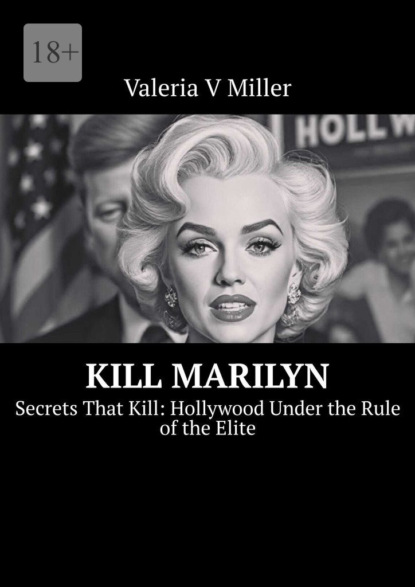
Valeria V. Miller Kill Marilyn. Secrets That Kill: Hollywood Under the Rule of the Elite
- + Увеличить шрифт
- - Уменьшить шрифт
“My mother looked at me as if I wasn’t me. Then she lunged at me with the pillow. I thought I was going to die,”
— Marilyn recalled, as reported by biographers.
This incident was the last straw, after which Gladys was immediately hospitalized, and the girl was placed with a foster family. The fear of inheriting her mother’s illness — already as an adult — haunted Marilyn throughout her life; she would panic at the thought of “going crazy like Mom.”
“I was afraid all my life that I would go crazy like my mother. Sometimes I felt — she was inside me. And I clung to glamour, to men, to pills, just to avoid being alone with myself,”
— Marilyn said in an interview (Sam Staggs, Inventing Marilyn, 2000).
“Sometimes I just lie there, afraid to open my eyes. I think, ‘What if I’m already like Mom?’”
(From Marilyn’s letters to Dr. Green, her psychiatrist, 1959)
Marilyn recalled that her mother never touched her with love, never hugged or kissed her. She was distant, frightening, and cold.
“My mother… she didn’t look, she drilled. Her gaze was icy. I was afraid of her because I couldn’t tell where the human ended and something else began. She wasn’t cruel. She was just… not mine. I was her mistake.”
“She didn’t scream. She just looked. Looked as if I were something foreign, frightening,” Marilyn recalled. “And I knew: I had to be quiet, invisible, preferably — not breathe at all.”
— Anthony Summers, Goddess: The Secret Lives of Marilyn Monroe, 1985.
“Gladys never hugged her. Marilyn recalled that her mother kept her distance even when the girl was sick or crying. ‘She said that love makes children weak,’”
— Donald Spoto, Marilyn Monroe: The Biography
A study of the Baker family genealogy reveals cases of mental illness and suicides among close relatives. Gladys was hospitalized more than 20 times during her life, indicating the chronic and progressive nature of her illness. She spent her final years in strict isolation and died under complete isolation in 1984, in a psychiatric hospital. Marilyn’s older half-brother (on her mother’s side), Robert Kermit Baker, was born in 1917. He also suffered from serious mental disorders like his mother. He was committed to a psychiatric hospital in his youth and died there at the age of 30, in 1933, when Marilyn was only 7 years old. Marilyn never saw him. He disappeared from her life before she even realized she had a brother. His name was rarely mentioned — as if people wanted to erase the very fact of his existence.
Quote from biographer Donald Spoto (Marilyn Monroe: The Biography):
“Robert was a taboo. No one spoke of him. It was as if he did not exist. He was the first ghost in her family, and far from the last.”
Bernice Baker Miracle, born in 1919, was Marilyn’s sister, but Marilyn only learned of her existence at the age of 12. Until then, she did not know she had a sister. In their youth, they never interacted because Bernice was given into the care of her father in Kentucky. Their mother did not maintain contact. They met for the first time when Marilyn was already a teenager.
“When we first talked, I thought she was joking. A sister? Mine? But then I saw something familiar in her — her eyes, lips, expression.”
— Marilyn, recalling Bernice’s memories.
Later, when Marilyn had already become an actress, they occasionally corresponded and met rarely, but their relationship remained strained. Bernice later wrote:
“I was like a strange reminder of the past she was running from. She didn’t know how to talk to me — we were almost strangers.”
In this family, there was neither kinship nor warmth — only the genes Marilyn feared she might inherit. Her childhood was spent in orphanages and foster homes, where she was unloved, misunderstood, and often treated cruelly. Constant relocations and the feeling of rejection and helplessness shaped a sense of complete social insignificance. Norma Jeane understood perfectly well that there was almost no chance to escape such an environment. Her memories are full of bitter phrases:
“I am nobody. No one wants me, no one waits for me, I was just thrown into the garbage.”
“I didn’t know who I was. I didn’t know why I was born. I didn’t know who I belonged to. And I learned: to no one.”
— Norma Jeane Baker (Marilyn Monroe), in conversation with Ben Hecht, 1954
Marilyn Monroe was born out of wedlock, and her life from the very beginning was a stark, ugly demonstration of how the system treats children whose parents are absent. Her mother, Gladys, suffered from a severe mental disorder and was admitted to a psychiatric hospital shortly after giving birth. Her father — Charles Stanley Gifford — tall, well-groomed, and proper, refused to acknowledge paternity. He neither paid support nor visited. She was neither adopted nor rescued — she was passed “from hand to hand.”
“I was something like luggage to them, something that could be handed from one person to another.”
Конец ознакомительного фрагмента.
Текст предоставлен ООО «Литрес».
Прочитайте эту книгу целиком, купив полную легальную версию на Литрес.
Безопасно оплатить книгу можно банковской картой Visa, MasterCard, Maestro, со счета мобильного телефона, с платежного терминала, в салоне МТС или Связной, через PayPal, WebMoney, Яндекс.Деньги, QIWI Кошелек, бонусными картами или другим удобным Вам способом.