Полная версия:
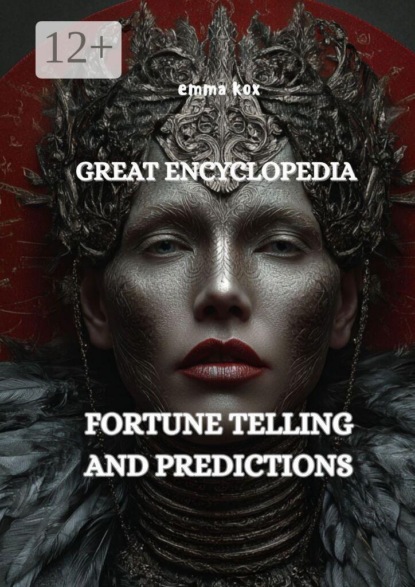
Emma Kox Great encyclopedia. Fortune telling and predictions
- + Увеличить шрифт
- - Уменьшить шрифт

Great encyclopedia. Fortune telling and predictions
Emma Kox
© Emma Kox, 2026
ISBN 978-5-0070-3262-9
Created with Ridero smart publishing system
Chapter 1.0. INTRODUCTION

For as long as humanity can remember, it has tried to peer ahead — into the mist that hides the coming day. In stone caves, shamans cast bones and burned sacred herbs. In ancient temples, priests deciphered the trembling of bird entrails. On medieval squares, old women laid out cards. And in the age of the internet, analysts launch neural networks to predict Bitcoin rates or election outcomes.
All of this is prediction. And while the forms may change, the essence remains the same: humankind has always hungered for ways to understand what has not yet come to pass. Prediction is a form of interpreting the future, based on signs, knowledge, symbols, or logical models. At its core, it unites two seemingly opposite sides of human nature: the rational — which includes analysis, calculation, logic — and the intuitive — insight, revelation, and omens.
Let’s turn to history for a moment. One of the earliest known predictions is recorded in Sumerian cuneiform, dating back to around 2500 BCE. Priests observed the movements of stars, lunar eclipses, and animal behavior to foresee the fate of kings.In Ancient Greece, for example, the Delphic Pythia, inhaling vapors rising from a crack in the earth, delivered prophecies to rulers and generals. In China, the I Ching system of divination evolved — based on combinations of six-line hexagrams that reflected the ever-changing dynamics of the world. And in Renaissance Europe, astrology and alchemy were considered part of legitimate science — many great minds, including Isaac Newton, were deeply engaged in the study of the stars. This shows just how seriously prediction was taken — not only by ordinary people, but also by the most respected scientists, historians, and members of the aristocracy.
Picture a king standing by a border stream. Before him lies an unknown land. Behind him — an entire kingdom. The fate of thousands depends on his decision. What does he do? He calls for a seer. Because no matter how powerful he is, he still fears the unknown. That is the archetype — one that lives within us to this day.
Let us ask ourselves a simple question: Why do people seek to know the future?
The answer, surprisingly, is simple. We are afraid. We hope. We want control. We don’t know how to wait.
Prediction becomes a way to cope with what lies beyond our grasp. According to research by neuroscientists — such as Antoine Treisman — the human brain is naturally wired to anticipate. It’s a built-in function: the brain constantly models the future in order to better respond to danger and make decisions. We live in a state of continuous forecasting, even if we’re not aware of it. Imagine a person standing at a crossroads.
Three roads lie ahead, and none are lit. He reaches out to the first sign he can find.
Maybe it’s a Tarot card. Maybe it’s a cast of the I Ching. Maybe an astrologer’s advice or a neural network’s prediction. This isn’t just a desire to know what will happen — it’s a deep need to feel confident in the present moment.
Beyond fear, there’s something else driving prediction: the search for meaning.
Especially in times of crisis — after world wars, during pandemics, or amid technological upheaval — interest in divination, prophecy, and psychological tools surges dramatically.
People don’t always seek a precise answer. More often, they seek a direction.
Not “What will happen?” But “What should I do?”
Two Ways of Speaking About the Future: Science and Mysticism. The modern world offers two distinct “languages” for talking about the future:
The scientific view. This perspective is built on probability, data, and models.
Science constructs forecasts using information: weather simulations, economic projections, psychometric analyses. It’s a deterministic approach — if we know all the variables, we can predict many outcomes. But not all. In 1956, the first predictive computer program was created — a chess engine capable of forecasting moves.
Today, AI predicts disease progression, natural disasters, and market behaviors with remarkable precision.
The mystical view. This perspective operates with symbols, archetypes, and intuition. It’s not logic — it’s poetry. Not linearity, but metaphor. Here, precision is less important than meaningful resonance. Tarot, runes, dreams, numerology — these are not direct answers, but tools of inner imagery. The renowned psychoanalyst Carl Gustav Jung spoke of synchronicity — “meaningful coincidences.” He viewed predictions as a way to activate the unconscious and subconscious parts of the mind.
It’s worth noting: Even among scientists, there is no full consensus on whether everything can be predicted. Quantum physics, for example — especially Heisenberg’s uncertainty principle — suggests that at the most fundamental level of reality, true unpredictability exists. Which means there will always be space for intuition, metaphor, and mystery.
Before you lies neither a final set of truths, nor a religion, nor a set of instructions.
It is a collection of keys — and each one opens its own lock. Here you will find:
— Overviews of ancient systems of divination: from Sumerian astrology to Norse runes.
— Descriptions of modern approaches: predictive analytics, decision psychology, digital oracles.
— Tools you can experiment with: from simple fortune-telling to strategic planning.
We invite you to view prediction not as a verdict, but as a way to see differently.
Not to seek certainty, but to find direction. Not to know for sure, but to gain the clarity that helps you move forward. This encyclopedia is not a map of the future.
It is a lantern to illuminate your path in the dark — and perhaps help you notice what you’ve been walking past all along.
An enormous amount of cultural, spiritual, and political energy has been invested by humanity in the attempt to foresee the future. This is not an isolated phenomenon — it is part of civilization itself. If we look back in history, we’ll recall that in Ancient Rome, there was an official state position: the auspex. He observed the flight of birds to determine whether the gods approved a military campaign or political decision.
Without his conclusion, the Senate had no right to act. This wasn’t superstition — it was part of the state mechanism. Among the Aztecs and Maya, predictions were embedded directly into their calendar systems. Their priests conducted astronomical observations with such precision that even modern researchers are amazed.
Based on their calculations, favorable days were chosen for sacrifices, wars, weddings, and harvests.
Even in Ancient China, the imperial court had an entire astrological department, whose task was to forecast eclipses.
Missing a single eclipse could be considered a political scandal — and might cost the imperial advisor his life. Now picture this: A priest stands atop a ziggurat, beneath a darkening sky. The wind carries dust and the scent of an approaching storm.
Below, a crowd waits for his answer: Will the rains come? Will the gods descend?
Will the king survive? That priest is the ancestor of today’s data analyst, tarot reader, and even artificial intelligence. Because the question remains the same:
What lies ahead — and what should we do now? Because the question has remained the same. By gathering together diverse historical facts, we can clearly see how the concept of prediction has transformed over the course of human development. At different points in history, humanity has perceived the future in different ways:

“To predict is to see that which has not yet happened, but is already present in the hints, shadows, and patterns of reality.” — Umberto Eco, renowned Italian writer, philosopher, semiotician, cultural historian, and literary critic — best known for his novels The Name of theose, Foucault’s Pendulum, and Baudolino.
Thus, we have traveled a long road — from divine inspiration to statistical probability — but the need has remained the same: to foresee, to prepare, and to choose wisely.
The first is determinism — the belief that everything is already decided, that fate is written, and we are merely playing out a pre-written script.
The second, its opposite, is the belief in free will — that the future is made up of countless crossroads, and our choices determine the path we take. In this context, prediction becomes a tool for navigation, not a sentence. It may offer guidance, but it does not compel.
Neuropsychology confirms that even the illusion of control helps reduce anxiety and allows people to make more confident decisions. That is why even those who claim not to believe in fortune-telling often turn to it in pivotal moments — the brain needs an anchor.
Thus, this book will not give you a guaranteed answer — because there are no answers carved in stone in this world.
But it can:
— introduce you to ancient and modern systems of prediction;
— give you keys to symbols, archetypes, and interpretations;
— help you find direction when you’re at a crossroads;
— serve as a mirror for self-discovery and inner dialogue;
— and become a tool — not a dogma.
And before we turn to the body of the book itself, it’s important to remember:
the future is always about the present. When we ask, “What will happen?”, we are really asking: “What should I do now?” “Who am I at this moment in time?” “How do I avoid missing my path?” In the end, all prediction is a conversation with oneself. And may this encyclopedia become your guide in that conversation — honest, deep, and truly captivating.

Chapter 2. Three Paths into the Fog: Classification of Prediction Methods
The future — our eternal unknown — resonates within each of us like a delicate, nearly imperceptible string. We look forward with anxiety, with hope, with questions. Thus, across the centuries, humanity has devised methods to peer into that place where nothing has yet occurred, yet something is already felt — in our skin, in our breath, in our sixth sense. Prediction is not merely an attempt to know what lies ahead. It is the desire to find certainty, to discover a path, to feel that we are not alone facing the chaos of what’s to come. There are countless techniques, forms, and systems of foresight, but they can be broadly categorized into three principal directions: mantics, prophetic practices, and symbolic systems. Like three distinct musical instruments, they sound differently — but they play the same melody: the melody of human longing for knowledge.
2.1. Mantics — Fortune-Telling or a Dialogue with Chance
Mantics is the most ancient art of prediction. The term derives from the Greek mantikē technē, meaning “the art of divination.” Today, we commonly refer to it as fortune-telling. In mantics, chance is paramount. A coin landing heads up, a card drawn from a deck, a stone landing toward the north — all are ostensibly random events. Yet, to the person seeking answers, these become hidden signs of destiny. Here lies the paradox: chance becomes a message — if you are open to hearing it.
The Sumerians read the future by examining the livers of sacrificed animals, believing the organ reflected the gods’ will In ancient China, diviners used oracle bones — heated turtle shells or ox scapulae — interpreting the patterns of cracks that formed as messages from the heavens. In ancient Rome, up to twenty forms of mantics were practiced — from observing bird flights (auspicy) to interpreting lightning or celestial phenomena (astropomancy). During the European Middle Ages, peasants divined using candle shadows, wax drippings, and charred remnants. In Russian villages, Svyatchnye gadaniya were popular: young women tossed a boot over their shoulder, stared into mirrors by candlelight, listened to the direction of a dog’s bark to foresee a future husband. Among Shang Dynasty shamans, diviners performed rituals using divinatory bones, bridging this world and the spirit world Mesoamerican cultures — such as the Aztecs and Maya — used the tonalpohualli, a 260-day divination calendar. Each day held a unique symbolic structure and meaning, guiding life events, ceremonies, births, and decisions
In the Central Asian steppes, shamans practice Kumalak — a system that uses 41 beans, stones, or relics (occasionally sheep droppings). These are arranged in piles and placed on a 3×3 grid, with each square representing elements, body parts, and temporal aspects: past, present, future Across Europe and Western Asia, many divination forms existed, each named using the Greek -mancy suffix: pyromancy (fire), crystallomancy (crystal-ball reading), geomancy (earth), capnomancy (smoke), ornithomancy (birds), and more. Mantics is a spontaneous connection to the unknown. It does not depend on expertise — rather on intuition, sensitivity, and trust in the image. What truly matters is not how a card lands, but how you interpret it. In the hands of the doubter, a card remains silent — but in the hands of one searching for meaning, it begins to speak.
2.2. Types of Divination: From the Unusual to the Familiar
Divination is an attempt to read the signs of fate in a wide variety of things — objects, phenomena, symbols. Here are just some of the methods found in traditions around the world:
— Tasseomancy (Tasseomancy): Reading patterns in coffee grounds or tea leaves. The image in the cup is perceived intuitively — and it begins to “speak” of the present and the future.
— Ovomancy: Divination by the shape of the egg white of a boiled egg — for example, a ring might foretell a wedding, a serpentine pattern a warning.
— Charm casting (forecasting using a set of symbolic pendants): You lay out pendants on a mat, and interpret the answer to your question by their arrangement.
— Cleromancy: Throwing dice, stones, or shells and reading the signs in their arrangement. In Africa, divinations are done using shells, calling upon spirits or orishas.
— There are hundreds of other methods: divination by fire (pyromancy by earth), by clouds by books (bibliomancy by tarot and runes, and even by beans, handwriting, and much more.
— Card divination is the most widespread and familiar form of divination.
Mechanically learning how to perform divination is certainly within everyone’s reach. However, accurately interpreting information from the cards is a true art — one that requires continuous learning, simultaneously cultivating intuition, and expanding your broader esoteric understanding of the world. Try experimenting with various methods of divination; perhaps a cup of coffee speaks to you more than cards do. Test out two or three different approaches and select the one with which you feel a connection. Find the method that suits you best. Record everything: the technique used, the question asked, the symbols seen, your impression, and the outcome. This practice builds a “language” between you and your divination tool. Don’t shy away from intuition. One Reddit user wrote: “I stopped Googling card meanings and began focusing on the image, visual cues, and context of the spread — this is the real connection.” Keep those words in mind. Over time, accuracy in your divination will come with experience. Don’t criticize yourself for inaccuracies. The more you practice, the clearer your sense and interpretation will become. Divination is not a gift we’re born with; rather, it’s like a language of intuition and symbols — you learn it over time. It’s akin to learning to drive: initially unsteady, then smooth and confident. What matters most is curiosity and regular practice. Prepare yourself before a reading. Create a small ritual environment — clear the table, cultivate calm, and establish a connection between yourself and your tool. Listen to your inner voice and trust the images that arise. Be patient and observant. Divination is not about precise results, but rather about embarking on a conversation — with yourself and with the world.
2.3. The Difference Between Tarot Cards and Playing Cards for Divination
— Tarot comprises 78 cards—22 cards of the Major Arcana, which reflect major life stages, archetypes, and significant transformations; and 56 cards of the Minor Arcana, which describe everyday situations and states. Each card is rich with imagery, symbolism, and color — you can read it like a small poem. Playing cards are simpler: four suits, numbers, and face cards. Their meanings are often tied to suit and number — for example, Hearts represent emotions, Diamonds (or Pentacles) symbolize finances or material matters, and Spades (or Clubs) suggest challenges or obstacles. It is important to note that in many cultures, playing cards are the oldest form of cartomancy. What matters most is not the design, but your connection with the practice.
— Tarot is often used to understand deep, global processes in life — archetypes, inner growth, spiritual challenges. Playing cards are more suitable for specific, everyday questions: work, relationships, short-term events — they’re more direct and akin to a live conversation here and now.
— Tarot inspires and functions as a mirror of your inner world. It’s perfect for those emphasizing symbolism, depth, and archetypes. Playing cards, on the other hand, are everyday tools — simple and familiar. They’re practical and well-suited for direct interpretation or addressing practical matters. Both are simply tools. The key to effective use lies in your attention, your intuition, and your practice, not the tool itself. Tarot suits deep questions, transformation, and archetypes. Playing cards work well for the “here and now,” everyday situations, and clear answers. What matters most is how you read the cards: whether you sense meaning, see patterns, and trust your intuition. And always remember — the essence is not in the cards, but in you.
Mantics is like a randomly plucked petal falling before you, and you sense the truth. It is the world’s mirror into which we gaze when the mind grows weary and silence calls. When one chance occurrence becomes a symbol, you feel a connection: with ancestors, with the night breeze, with your inner light. A card, a grain, a shadow on a bone — all awaken. Mantics is not just divination. It is a dance with chance, in which meaning is born here and now. Mantics, or fortune-telling, remains alive and refuses to die. People yearn to interpret the unknown, to hear “something” — even when we know it is but an image. Divination provides a sense of control, even if it is an illusion. After all, even such a small sign can offer support. Mantics (divination) sparks thought, helping you see inner configurations: “What do I feel? What matters to me?” Cards, stones, bones — they are the language of the subconscious.

Chapter 3. A Voice Arising from Within or Above
If mantics is a look outward, then prophetic practices are a glance inward. It is when a person does not seek a sign in clouds or a shadow on a wall. They seek it in their own state, in altered consciousness, in trance, ecstasy, or sudden illumination.
Imagine yourself on a long autumn road beneath a grey sky. A gust of wind stirs the branches, and you suddenly hear a quiet voice within: “Be ready.” That is prophecy — not a card, not a clear sign, but a subtle revelation that allows you to feel the future’s step. Prophecy is not divination by chance — a card or stone turned cryptic. It doesn’t require systems like Tarot or I Ching, with their language and structure. Instead, it is an internal vibration, a voice that arises from deep within — whether through trance, dreams, insight, or vision.
The history of prophecy is as ancient as humanity itself. In Ancient Egypt, it was believed the Pharaoh could communicate directly with the gods — especially in dreams. In Ancient Greece, the Pythia sat on a tripod above a fissure, inhaled vapors, and spoke in a trance on behalf of Apollo. Priests recorded her words, and rulers interpreted them. In the Bible, prophets — from Moses to Isaiah — spoke not by personal will, but at the command of a “voice from above,” sometimes against their wishes. In Islamic tradition, prophecies (wahy) were considered direct revelations from Allah, delivered to the Prophet. But prophecy is not always tied to religion. In the mystical traditions of Sufism, in the shamanic practices of Siberia and the Amazon, and in rituals involving psychedelic plant medicines (ayahuasca, peyote), people entered states where they “saw” and “heard” the future. In the twentieth century, automatic writing, trance speech, and channeling — the method of working with the subconscious and intuition, accessing the deeper layers of the psyche where archetypes and images reside — became popular ways to “receive messages.”
Modern science says that during such moments, shifts in neural activity occur — the functioning of the frontal lobes changes, and consciousness reorganizes. Psychology adds that one enters contact with the deep unconscious, where symbols, archetypes, and ancient wisdom are stored. Prophecy is not prediction in the classical sense. It is a message — often allegorical, strange, needing interpretation. It is a voice you do not always believe, but cannot ignore. Prophetic states are often linked with immersion in a special mental condition — similar to transcendental memory, deep archetypes, or the unconscious. Modern studies show that meditation activates diverse parts of the brain, including frontal zones and areas of focused attention. Similar states are possible during a prophetic session: the brain suspends ordinary logic and opens access to deep perception. Imagine a lake — its surface mirrors the sky. Suddenly, someone throws a stone, and a wave spawns an image on the water. You gaze at it — and see that where the water trembles, a message is hidden. Prophecy is like a soft bell in the soul. It does not shout, “This will happen!” It whispers, “This might be…” It is both an illusion and a responsibility — a combination of anxiety and hope.
Let us look at some of the most famous examples of fulfilled prophecies. For example, Nostradamus, known for his precise predictions, a master of dreams and reflections, foresaw “The blood of the just will be lacking in London,” a phrase linked to the Great Fire of 1666. He is also attributed with predicting the French Revolution, Hitler’s invasion, and the division of the world. Siener van Rensburg, a South African seer, predicted the 1918 pandemic — “a terrible plague” that would engulf all nations. Within months, the Spanish Flu raged through his country. Elder Ariostklius in Russia foresaw the onset of calamities, wars, and the collapse of the tsarist realm — his words are quoted as prophetic at the beginning of the 20th century. And there are hundreds, if not thousands, of such fulfilled prophecies throughout human history.